
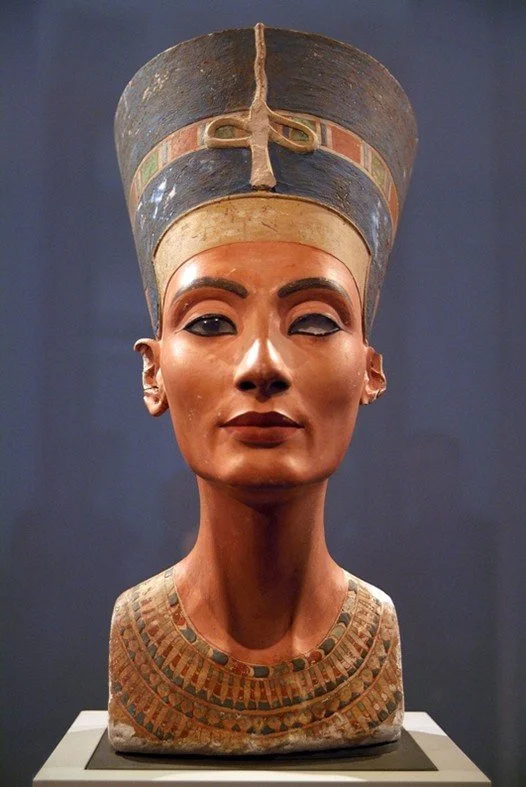
Queen Nefertiti, Amarna period, Egypt
Tuesdays, September 2, 9 & 16, 2025
7:30 PM
Whose face do we see in a portrait? Is it a likeness, character study, or the truth? Today, portraits can be enhanced through multiple software effects and AI. What evidence do we have for portraits from antiquity around the Mediterranean region—exploring portraits of historical individuals from Mesopotamia and Egypt, Greece, and the Roman world? In this series we will consider artistic challenges in creating a portrait of someone who died centuries earlier or who was known only by distant reputation. Ranging from the third millennium BCE through the second century CE, sculpture, coinage, and paintings will bring us full circle from deep antiquity to the astonishingly vivid Fayum portraits discovered in an area of ancient Egypt following Greek and then Roman occupation.
September 2 » Decoding Portraits from Antiquity: Mesopotamia and Egypt
How is power revealed? Kingship in portraiture is usually made with enduring materials such as bronze and stone that survive for millennia. Sargon, king of the Akkadian empire, is likely the subject of one of the finest and most costly bronze portraits from Mesopotamia. Through their royal workshops, rulers from Egypt established and controlled distinctive images in stone during the Old and New Kingdoms, perpetuating a youthful and virile image. While these were the standards, exceptions emerged during the Middle Kingdom and again during the succession of queens in the Amarna period of the New Kingdom, most notably with the presentation of the celebrated and beautiful Nefertiti. Beauty and high status, however, were not always the goals.
September 9 » Decoding Portraits from Antiquity: Greece
How is knowledge expressed? Portraits of Greeks tended to revolve around famous individuals from the areas of philosophy, literature, and leadership. The first portrait of Homer was created three centuries after he lived. How did the sculptor approach the challenges of this unknown subject? In general, creating an ideal image seemed to be the goal in the Greek world, but the shock of ugliness in portraits of Socrates introduced new options. The portrait could include a multisensory experience, including visually stimulating colors and olfactory scents, as recent research reveals. The Greek speaking world continued to expand, and portraits of the wider populations changed as well, from North Africa to the Greek East. A new emphasis is seen in individualized portraits of people we might expect to see in our own local communities.
September 16 » Decoding Portraits from Antiquity: The Roman World
How is authority represented? Romans commissioned portraits in abundance, whether for members of the imperial family or people of lesser rank. Augustus, the first emperor, imbedded in his portraits features and details understood by the well-educated, often with direct allusions to famous Greek examples. Dynasties developed their own visual language for the men and women, establishing portrait trends for the masses. In the second century CE, Emperor Hadrian brought back the short-cropped beard, not seen for more than five hundred years. Communities in northern Egypt, part of the Roman empire, retained traditions established as early as the Old Kingdom, while adapting the prevailing traditions of recent Greek and then Roman occupation. The resulting painted portraits, best known from the Fayum funerary district, bring us into direct contact with people who are individualized and compellingly contemporary to us.
About Dr. Katherine A. Schwab
Katherine Schwab received her BA from Scripps College, her MA from Southern Methodist University, and her PhD from the Institute of Fine Arts, New York University. She is Professor Emerita of Art History & Visual Culture at Fairfield University, former curator of the Plaster Cast Collection at the Fairfield University Art Museum (1991–2024) and was Founding Director of the Arts Institute established in 2023.
While specializing in ancient Greek art and archaeology, her research focuses on the Parthenon sculptural program. Scans of her metope drawings are permanently displayed in the Acropolis Museum. The original drawings formed a traveling exhibition in the United States from 2014 to 2018, including at the Timken Museum of Art. Her research extends to the Caryatid Hairstyling Project (film, 2009; exhibition Hairstyles of the Classical World, 2015) and historic plaster casts of ancient sculpture. Her drawings and photographs formed three separate exhibitions at the Greek Consulate General in New York City.
Schwab was a member of the Managing Committee of the American School of Classical Studies at Athens and returns annually to Athens for her research. Recently retired, she resides in San Diego and continues to conduct research in her focus areas.
Series Tickets: $42/57
The lecture will be in person at the Athenaeum Music & Arts Library. There are no physical tickets for this event. Your name will be on an attendee list at the front door. Doors open at 7 p.m. Seating is first-come; first-served. Priority seating will be given to Donor level members and above.
Ticket Confirmation Notice:
Your reservation is not complete until you receive an email confirmation. If you do not receive a confirmation email, your tickets have not been reserved. Please check your inbox and spam/junk folder or contact us at info@ljathenaeum.org or (858) 454-5872 to ensure your booking is finalized.
Thank you!