
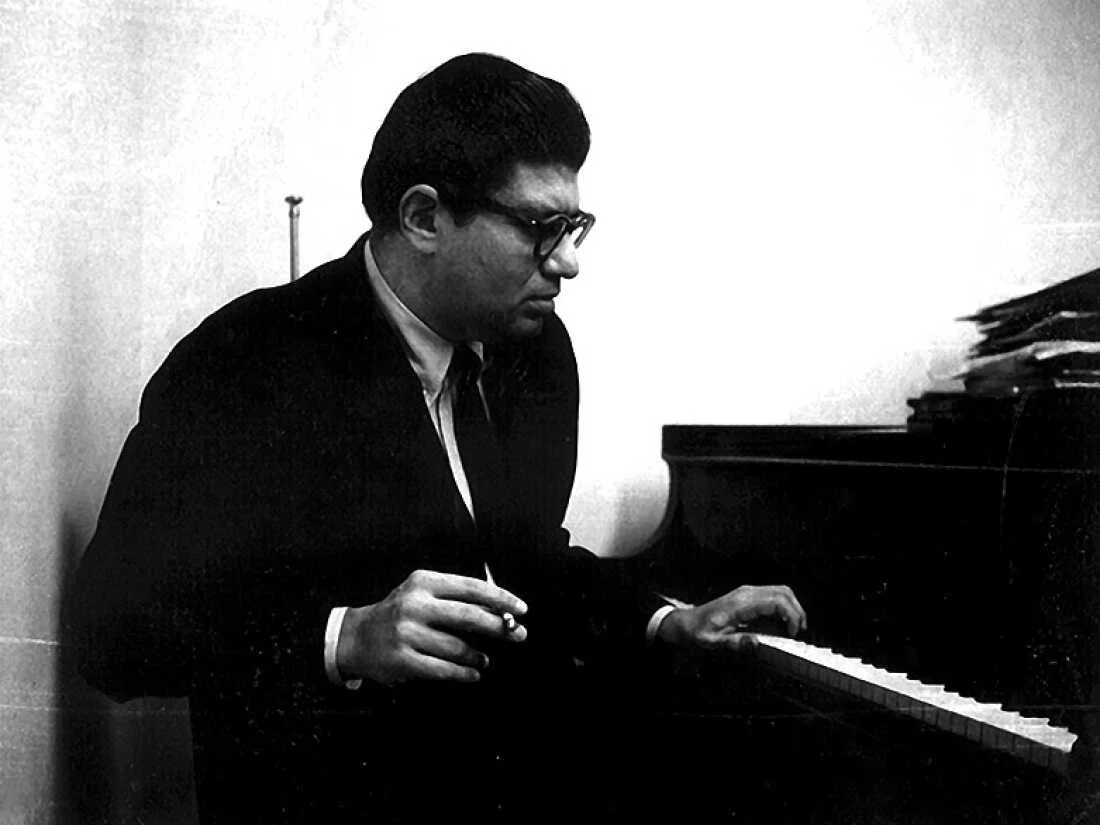
Morton Feldman
Wednesday, May 20, 2026
7:30 PM
San Diego New Music joins in the celebrations of the 100th birthday of experimental composer Morton Feldman with a performance of his 1985 ensemble work Piano and String Quartet featuring pianist Vicky Ray and the Eclipse Quartet.
Piano and String Quartet
In the opening bars of Piano and String Quartet, Morton Feldman offers what feels, at first encounter, like a nearly static proposition: the piano traces a gentle ascent while the strings suspend a quiet chord in place. For a first-time listener, this gesture can seem less like a beginning than a condition—something already underway, something that may simply continue unchanged for the duration of the piece’s nearly 80 minutes. And yet, to hear the work this way is to misunderstand its central claim. The opening is not a fragment repeated, but a premise tested: how little can change and still constitute change?
Composed in the final year of Feldman’s life, Piano and String Quartet belongs to what is often called his “late” style—a body of work defined not just by extreme duration, but by a radical rethinking of musical form. While it is tempting to group these works under the broad umbrella of minimalism, Feldman’s music stands at a decisive remove from the pulse-driven processes and structural clarity associated with contemporaries like Steve Reich or Philip Glass. Feldman’s repetition does not accumulate toward pattern recognition or rhythmic entrainment; instead, it actively resists it. There is no grid, no cycle to lock into. Time is not organized—it is diffused.
A more precise analogy for this music lies in Feldman’s well-documented fascination with Persian rugs. He was drawn not simply to their beauty, but to their method: the way intricate designs unfold across a surface without exact repetition, producing a sense of coherence without symmetry. In Piano and String Quartet, musical material behaves in much the same way. Figures return, but never identically; intervals are displaced, rhythms are slightly altered, voicings rebalanced. What initially registers as sameness gradually reveals itself as a field of deviations. The listener is not asked to follow development in the traditional sense, but to inhabit a space where memory becomes unreliable—where one is never quite certain whether something has been heard before or only resembles something that has.
This is where the durational scale of the piece becomes essential, not excessive. Over time, perception recalibrates. The ear, deprived of large-scale contrast, becomes newly sensitive to the smallest inflections: the precise weight of an attack, the decay of a piano tone against the sustained breath of the strings, the way a chord seems to tilt ever so slightly as its internal balance shifts. Contrary to the assumption that Feldman abandons timbre in favor of abstraction, Piano and String Quartet reveals timbre as a structural force—one that only emerges fully through extended listening. The piece does not present its details; it withholds them, allowing them to surface gradually, almost involuntarily.
In this sense, Feldman’s late music proposes a different kind of attention—one not based on anticipation or arrival, but on persistence. The question is no longer “What happens next?” but “What is happening now, and how is it different from a moment ago?” What begins as a seemingly minimal gesture unfolds into a complex perceptual experience, where repetition becomes instability and stasis becomes transformation.
About San Diego New Music:
San Diego New Music is a nonprofit organization dedicated to the public performance of notated music of the highest integrity and artistic caliber from the 20th and 21st centuries. We seek to advance the art form by promoting music composed with conceptual rigor, passionate energy and singular artistic vision. SDNM enriches the artistic culture of San Diego through the presentation of an annual concert series and the soundON Festival of Modern Music, and through fostering its resident performing ensemble, NOISE.
In 1994, the only place in San Diego where you could hear an entire concert of 20th-century music was on a college campus. San Diego New Music pitched the idea of a concert series devoted to modern music and 20th-century classics at the Athenaeum. The concerts of modern music perfectly complement the exhibitions of modern art held in the Athenaeum’s galleries. In 1996, San Diego New Music presented its first season. The series was called "Noise at the Library," and the ensemble would later adopt the name, as well.
San Diego New Music and the Athenaeum have been happily co-presenting concerts of new music ever since.
For more information on the organization go to www.sandiegonewmusic.com.
The concert will be in person at the Athenaeum Music & Arts Library (1008 Wall Street, La Jolla, CA 92037). There are no physical tickets for these events. Your name will be on an attendee list at the front door. Doors open at 7 p.m. Seating is first-come; first-served. Priority seating will be given to Donor level members and above.
Ticket Confirmation Notice:
Your reservation is not complete until you receive an email confirmation. If you do not receive a confirmation email, your tickets have not been reserved. Please check your inbox and spam/junk folder or contact us at info@ljathenaeum.org or (858) 454-5872 to ensure your booking is finalized.
Thank you!