Anne Saitzyk
Saturdays, 10 AM–1 PM
March 28–April 25
(5 weeks, 15 total hours of instruction)
Zoom
$240/260
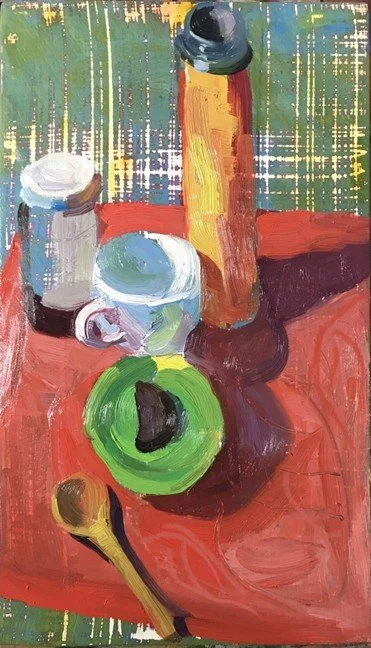
In this workshop, fast exercises are designed to celebrate your own discoveries by working intuitively and playfully within a certain parameter. Working fast can help us bypass perfectionistic tendencies and get to the point. We will also work slowly, building upon those discoveries to create a larger composition, considering the options for adjusting or editing, and building on the depth of what paint can offer. Working from your own still-life setups, interiors, and photo references, the hope is that you will break some new ground in your work. Photos can be provided if you prefer. The course includes slide presentations, instructor demonstrations, and group discussion. Working in oil is recommended, but other media are welcome. First day, be prepared to draw on paper, using fast and messy materials—i.e., charcoal sticks, ink and brush, or pastels. All levels are welcome.
Students will be asked to post their work to a Google Drive folder for class discussion.
Max students: 15
New Faculty!
Anne Saitzyk has been teaching painting and drawing for nearly 30 years, mostly at Pasadena’s ArtCenter College of Design Extension, as well as Otis College of Art and Design and Barnsdall Art Center, with some workshops across the United States and internationally. She received her MFA in painting from Claremont Graduate University and a BFA in illustration from ArtCenter College of Design. In Anne’s teaching, exercises and references to art history as well as contemporary work are meant to educate students in the foundations of art and inspire us to move beyond our habitual approaches and take a creative leap. She co-founded Contemplative Creativity Lab, a monthly gathering of artists exploring the meditative mind through art practices that was active for 10 years. She’s been teaching her classes online for the past few years and perhaps surprisingly, it’s been very effective in deepening participants’ artistic skills and maintaining a community of artist-students.
Materials: Paint: Oil preferred but other media are welcome. (Oil painters will need some acrylic. At minimum, choose one dark and one light color—i.e., blue and yellow or any two or three acrylic colors you like.)
Colors: The double primary palette listed here is a good minimum: Titanium White, Cadmium Yellow Light Hue, Indian Yellow, Cadmium Red Medium Hue, Alizarin Crimson (or Quinacridone), Ultramarine Blue, Cobalt Blue. (No black is needed.) If you have more colors beyond this, that’s great. “Hue” colors are fine. Gamblin 1980 is unique in that Gamblin uses a combo of Hues and true Cadmiums to make a lower cost semi-pro grade paint.
Acrylic painters: Mars or Ivory Black, Titanium White, Primary Cyan (or Cobalt Blue), Primary Magenta (or Naphthol Red Light), Primary Yellow (or Hansa Yellow Medium).
Other Media: Soft or medium compressed charcoal stick, chamois or tissue, and a small set of watercolors, watery acrylic, or liquid black ink for quick studies.
Supports: For painting, Strathmore or Canson Oil Painting Paper Pads, 9” x 12”. (Get a pad with at least 10 sheets.) One larger sheet, approximately 12” x 16” or as large as you like. Or use what you like … panel, canvas, chipboard, or paper, primed and ready to paint on.
Drawing: large drawing pad, like Strathmore Drawing, 14” x 17” or larger. “Drawing” paper is heavier than “Sketch,” so it could also be fine for watery media.
Brushes: Hog bristle (NOT nylon) brushes are best for oil. My favorite: Robert Simmons Signet filbert (good quality and value). One #8, which is ½” wide, and one smaller, such as a #5 or 6. These brushes also work fine, or you could get similar sizes in acrylic brushes. Additionally, one cheap 3” hardware store varnish brush.
Lighting: You’ll need a strong light source for many of our projects. See this variable temperature, high wattage LED bulb here. Here’s my favorite swing arm lamp, or get a cheap aluminum type of clamp light. These are a very important part of your setup in order to control your lighting.
Misc.: Large wax paper palette (12” x 16”); painting knife (offset handle, 3” long, 1”-wide at base); paper towels or rags.
Optional but recommended: “View Catcher” grey viewfinder (can be purchased at Blick), or I can show you how to make one with stiff paper.
For oil painters: Gamblin non-solvent gel or fluid.
Learn more about the art instructor.
Read feedback from past students.
Immediately after you register, look for a confirmation email and receipt. In the week preceding the class start date, you will receive another email with more details.
About Online Classes via Zoom:
The technology to take one of our online classes is surprisingly simple. You need only a computer or tablet with a camera, microphone, and internet connection, and we are here to help, should you experience any technical difficulties.