
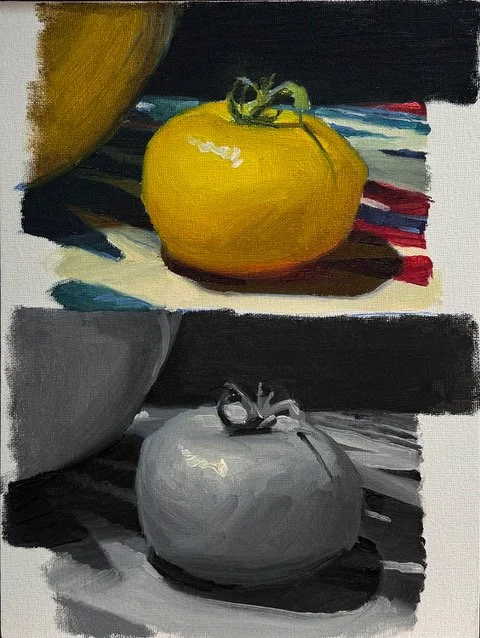
Ron Lemen
Monday–Friday, 6–9 PM
August 17–21
(5 days, 15 total hours of instruction)
La Jolla Studio
$240/260
Ever wondered why some paintings feel alive while others fall flat? This color theory class is where clarity replaces guesswork, and where you start to truly understand what your paint is doing. You don’t need a background in theory to get started. We’ll build from solid academic foundations, value, temperature, color relationships, and how light affects everything you see. You’ll learn how to mix colors with intention, control saturation, create harmony across a painting, and avoid the common pitfalls that muddy your work. These aren’t abstract ideas, they’re practical tools used by master painters to create believable, dynamic images.
The best part? You’ll gain control without losing your instincts. As the old saying goes, “The master acts without striving.” We’ll give you the structure from understanding color hierarchy, edge relationships, to how to organize a palette, but then encourage you to apply it naturally through practice. Some days your mixtures will hit perfectly and everything will click; other days you’ll chase a color and miss it entirely, only to realize how much sharper your eye has become.
Materials:
Paints: Preferred paints in oil: Buy Directly from the DaVinci Paints website—Titanium White, Cadmium Yellow Pale, Cadmium Yellow Orange, Cadmium Red Light, Alizarin Crimson, Red Rose Deep, Ultramarine Blue, Cerulean Blue, Viridian Green, Ivory Black.
Surfaces: Canvas Pads—I use 12 x 16” and 16 x 20” but scale is up to your preference, larger means more room for brush work.
Brushes: Brushes include at least one 1/4” Bristle Flat, two 1/2” Bristle Flat brushes, one Round preferably a sable, one 1/2” Bristle Filbert, one 1/2” Bristle Bright, and 1 Fan Brush, preferably a bristle as well. We are not using any sables except to draw with to make sure that our paint application is strong and opaque which makes it much easier to see the exact color that has been mixed.
Paper Towels: purchase a 4 pack of blue shop towels or box of shop towels from Home Depot. They are durable and do not flake into the paint the way regular paper towels can do so.
Mixing Knife: 1 Palette knife—for mixing color—RGM # 5 or 10, flexible, with a rounded end to it to prevent damaging your palette
Palette set up: Palette Paper—Reynolds Freezer Paper found at any grocer or online—get an 18 x 24” canvas board to act as a palette support. Can be purchased cheaply at Michael's.
Medium and initial brush cleaner: Linseed Oil and an Oil Cup: No Paint thinner is needed, in fact most of the time you paint you do not need thinner at all, unless you have an effect you are pushing into your work.
Immediately after you register, look for a confirmation email and receipt. In the week preceding the class start date, you will receive another email with more details.